Leaving Work at Work When You Work From Home
When your desk used to be twenty minutes away, the drive home did a job you didn't notice it doing. It marked the end of the day.
The office you can't leave
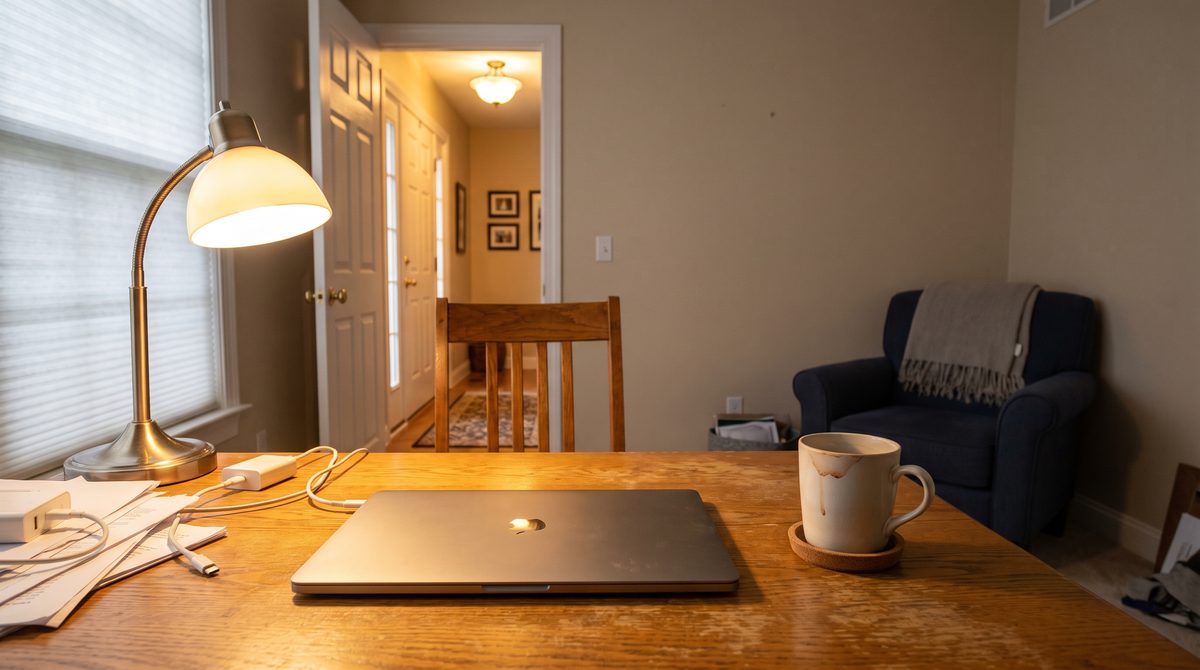
When your desk used to be twenty minutes away, the drive home did a job you didn't notice it doing. It marked the end of the day. Work from the spare room or the kitchen table and that marker disappears. The laptop is still there after dinner. The half-answered email is still open in a tab. Nothing physically stops the day from continuing, so you have to be the thing that stops it.
Why the workday won't end on its own
At an office, other people leaving is a cue. The building emptying is a cue. At home there's no equivalent, which means the workday now ends only when you decide it does, on purpose, every day. Skip that decision and the day just runs long by default, not because anyone asked you to work more, but because nothing told you to stop.
A shutdown routine that actually closes the day
A shutdown routine is not a to-do list. It's a short, repeatable sequence that tells your own head the day is over, the same way locking the office door used to.
- Write tomorrow's first task before you close anything. One line is enough. This is what actually lets your brain let go of today, because it isn't trying to hold "what do I do next" in memory overnight.
- Close the applications, not just the windows. A minimised tab is still a live thread. Closing the program is a small, deliberate act that says the workday is done.
- Change something physical. Put the laptop in a drawer, close the door, turn the chair to face away from the desk. If the workspace looks the same at 9pm as it did at 2pm, your head will treat it the same way.
- Say the day is done, out loud or to whoever's in the house. It sounds unnecessary. It works because it forces a clean handoff moment instead of a fade.
Do the same four steps in the same order every day. The routine works because it's boring and repeatable, not because any single step is clever.
Time management that survives constant interruption
Working from home with a family around means your day will be interrupted, and no calendar trick removes that. The goal isn't an uninterrupted day. It's a day that can absorb interruptions without your most important task being the casualty.
Put your hardest task first, before the house is fully awake or during a window you know tends to be quieter. Whatever's genuinely difficult should not be competing with the time of day when you're most likely to be pulled away.
Batch the small stuff instead of reacting to it as it arrives. Messages, quick replies, and minor admin all fit into set blocks, two or three times a day, rather than being handled the instant they show up. Constant task-switching is what actually eats a day, more than any single interruption does.
Keep a visible signal for "mid-task, please wait." A closed door, headphones, a small sign on the desk, whatever fits your house. It won't stop every interruption, but it gives the people around you a way to judge which ones can wait five minutes.
Expect the plan to be wrong by lunchtime and build in slack for that. A schedule with no room in it breaks the first time a kid is sick or a delivery needs signing for. A schedule with a buffer just absorbs it.
Habits that hold up with other people in the house
Habits fail at home for a specific reason: they assume conditions that a shared house doesn't guarantee. A habit that only works in total silence will collapse the first week school's off.
Build habits around what's actually reliable in your house, not what would be ideal. If the only genuinely quiet stretch is early morning, that's where the habit goes, not wherever it "should" go on paper. If lunch is never predictable because of pickups or a partner's own schedule, don't build a habit that depends on lunch being predictable.
Make the habit small enough to survive a bad day. A ten-minute shutdown routine will get done on a chaotic Tuesday. A forty-minute one won't, and once it gets skipped once, it's easier to skip again.
Agree the boundary with whoever else is in the house, rather than assuming they can read it. "Door closed means mid-task" only works as a system if everyone in the house has actually agreed to it, not just you.
Recognising you're carrying too much, before it costs you a bad week
This isn't about diagnosing yourself. It's about noticing the practical signs early enough to do something about them, the same way you'd notice a car running low on fuel before it stops on the motorway.
Watch for the day running later and later without more work actually getting done. That's usually not commitment, it's a sign the boundary between work and stopping has quietly disappeared. Watch for snapping at your kids over something small, more than usual, at the end of the day specifically. And watch for dreading the start of the workday itself, not a specific task, just the day.
Any one of these on its own is a bad week. All three together, for more than a couple of weeks, is worth treating as a signal rather than something to push through. If it's affecting your sleep, your appetite, or how you're functioning day to day and it isn't lifting, that's worth taking to a doctor rather than solving on your own. There's nothing to diagnose here yourself, and nothing to prove by not asking.
The one thing to do this week
Pick one shutdown step from above, the physical one is usually easiest, and do it at the same time every day this week, even on the days the work isn't finished. The point isn't finishing. It's proving to yourself that the day can end on a decision you made, not on exhaustion catching up with you first.